A competitive European industrial model already exists
What Biella shows us. What we can learn from it.
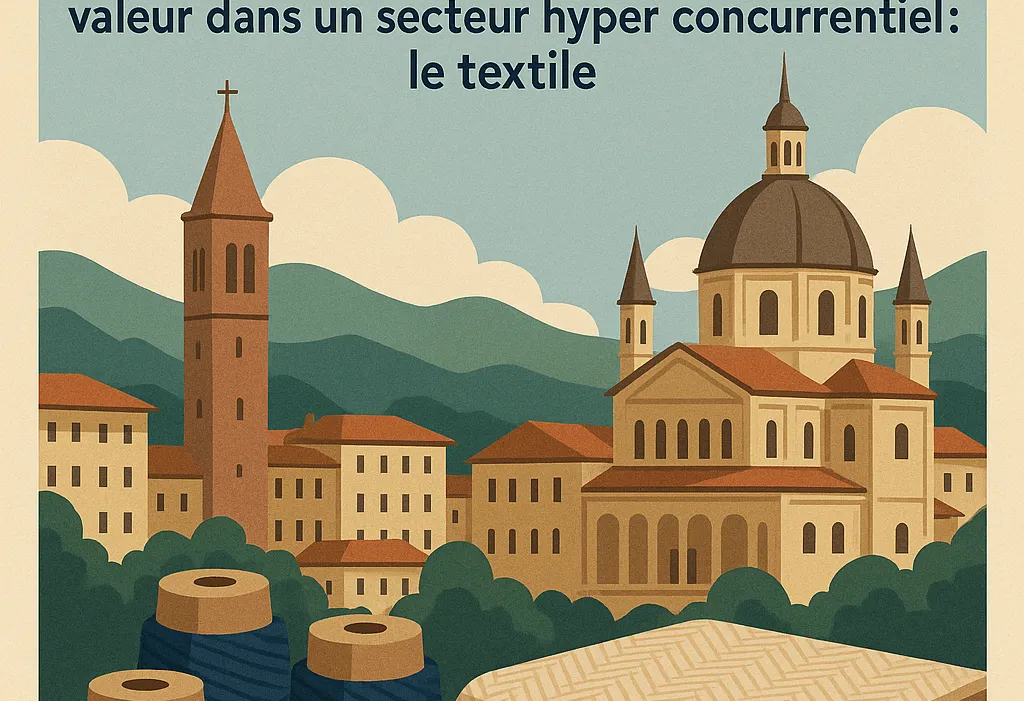
In Italy’s Piedmont region, at the foot of the Alps, an area with a population of 175,000 is home to more than 1,200 industrial SMEs. Half of them work in the high-end textile sector. Two-thirds of production is exported. The standards are global. And yet the fabric is local. Dense. Solid.
This area is called Biella. I discovered it in the 1990s as a buyer. Since then, I have been following its development. And at every stage, it has confirmed what I had sensed there: a European industrial model already exists. It is sober, rooted, rigorous. It trains, it produces, it endures.
Biella did not get swept away by the wave of offshoring. It made other choices. Structural choices. And reproducible ones.
It has invested collectively in quality, training, and the synchronized growth of its value chain. This symbiotic growth has been made possible by the performance of small businesses in the region, which themselves operate according to a logic of learning, specialization, and gradual stabilization. Their size is not a hindrance, but a lever: it allows for fine adjustments, direct responsibility for actions, and faster adaptation to customer constraints. The entire system obeys the logic of increasing returns to learning within units, and decreasing returns when attempts are made to over-centralize or lengthen the chain.
It has succeeded in making its professions visible, useful, and concrete for new generations. It has built cooperation between companies, on a human scale, without silos or dependencies.
The result is clear to see: a competitive industry that makes people want to train, commit and stay in it over the long term.
In Europe, a large baby-boom generation shaped the industry with high standards, technical skills, and professional culture. This generation is now preparing to leave the workshops. This transition is creating a major shift. It makes a clear strategy for passing on knowledge essential. Wherever this transfer is organized, the skills remain. Skills are built up. Quality improves. Biella shows this very clearly: training is not a burden, it is a strategy. A company that trains becomes a company that transforms.
Biella is textiles. Hexalean is metal. But the levers are the same. What we have undertaken in France is based on the same logic: local value chain, built quality, active transmission, carbon performance through intelligent sobriety. We are not starting from a dream. We are starting from an observation. And we are moving forward, block by block.
Let’s not be mistaken: 4.0 or investment are not the key to know-how. Industrial progress cannot be bought, it must be cultivated. It relies on trained, stable men and women, organized around the right actions, in a system that learns.
“Companies will only be able to overcome industrial disruption if they reinvest in skills and in their regional roots.”
— Institut Montaigne, Reindustrializing France by and for the regions, 2022
What Biella does on a regional scale, we can do on a national scale. Provided we consider industry not as a sector, but as a living, rooted, transmitted, and demanding structure.
Biella inspires people to produce. Because it produces well. Because it trains. Because it makes sense. That’s what attracts young people, customers, and partners.
The model exists. It works. It just needs to be adapted, passed on, and amplified.
Damien Vuillod
Hexalean Group
Metal industry – 8 sites – France